
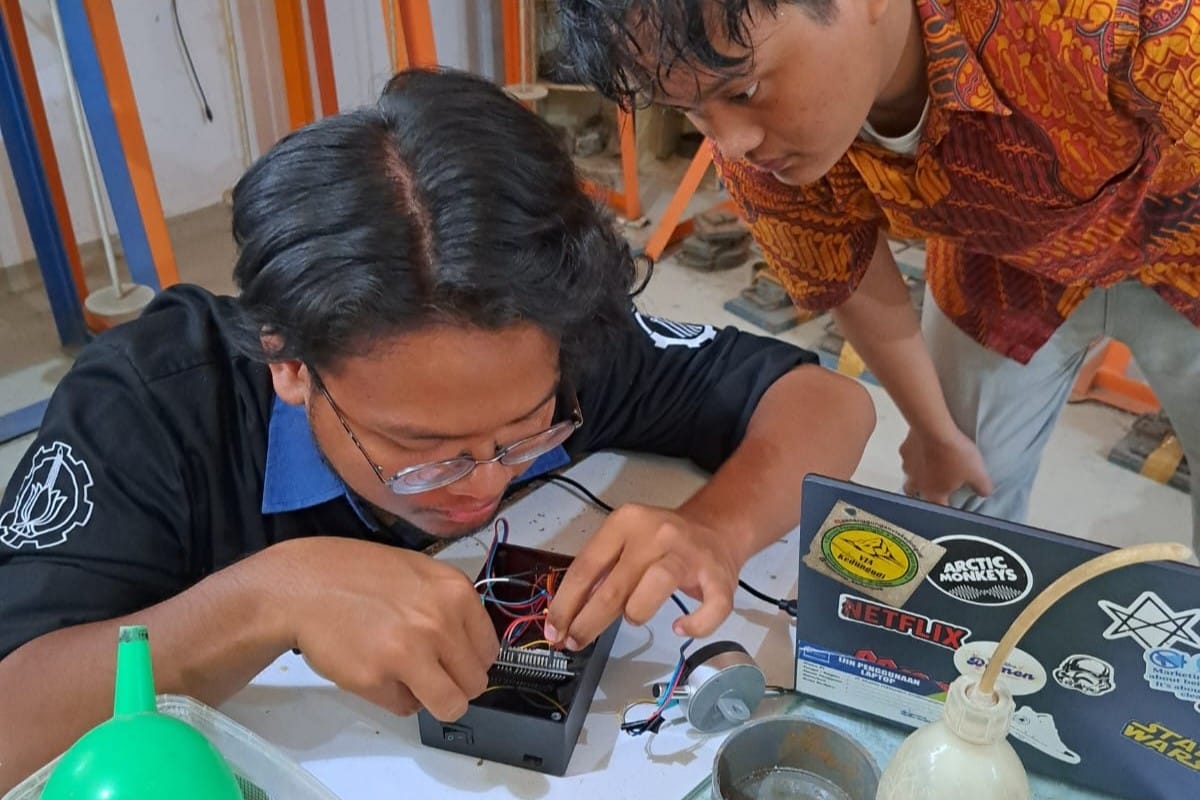
A collaboration between a team of students and lecturers from the Sepuluh Nopember Institute of Technology (ITS) has resulted in an internet of things (IoT) -based automatic dial reading system for soil consolidation testing. The innovation, called Consolink, is designed to simplify the lab process and minimize the risk of manual reading errors. Furthermore, this tool also allows real-time access to test data .
Consolink was developed to meet laboratory needs and will be developed into a system capable of automatically adding weights. Aan Fauzi, Head of the ITS Transportation and Geotechnics Laboratory, hopes that all laboratory equipment can be transformed into technology-based devices as part of infrastructure modernization. “We want all the equipment in the lab to become more sophisticated and, of course, more efficient,” he said.
Results of system connectivity tests on Consolink, a collaborative design innovation between ITS lecturers and students
Consolink Development Team Leader Deris Faisa Ralindra ST MT explained that Consolink’s development stemmed from a key issue with manual soil consolidation testers, which had erratic readings. This new system is designed to automatically record data at standard intervals without an operator in the laboratory. “This tool is very helpful because we no longer need to go to the laboratory in the middle of the night,” he said.
Besides addressing uncertain time constraints, manual consolidometers often experience technical issues, such as jammed dial gauge needles that require a tap to move them again. With a digital system based on a displacement sensor integrated with the ESP32, readings are more stable and accurate. “With this digital version, the level of accuracy is higher and there’s no longer the need to tap the dial like with the old method,” he explained